
Offshore Hosting Guides
What anonymous actually means here
Anonymous VPS hosting means you can rent a server without handing over identity documents, and pay in a way that does not tie the account to your legal name. That is a real and useful thing.
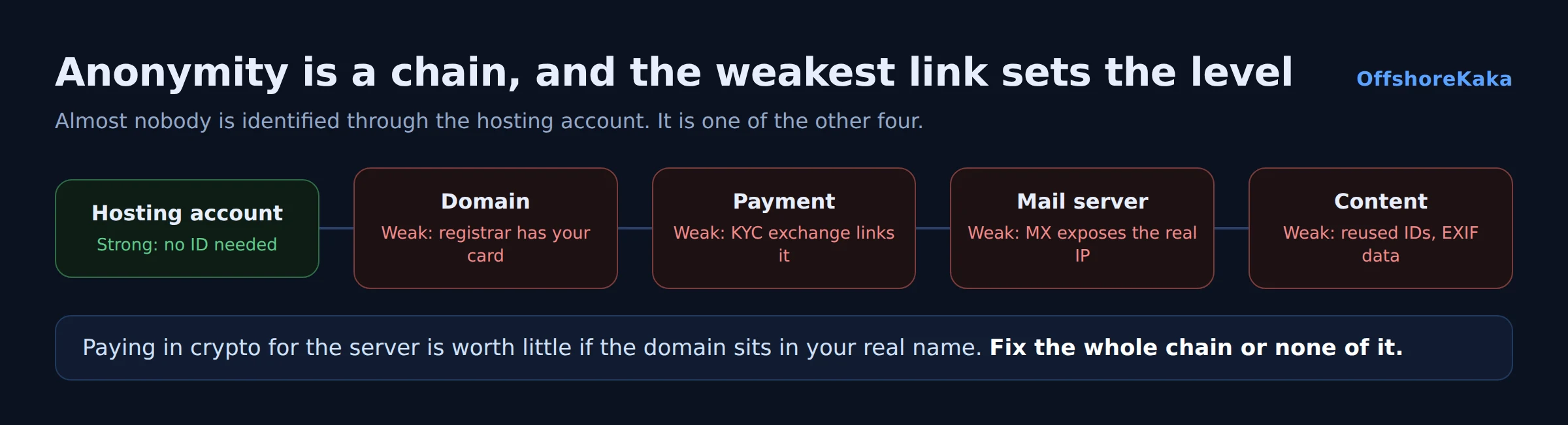
What it does not mean is invisible. Anonymity in hosting is a chain, and the server is only one link in it. This page is about which links are strong, which are weak, and where people give themselves away.
The chain
Every one of these connects your server to you, and the weakest one sets your actual level of privacy.
- The hosting account. Email address, payment method, and whatever ID was required.
- The domain. Registrar records, WHOIS, and how you paid for it.
- The payment. A card is your name. Bitcoin from an exchange with KYC is also traceable to your name, just with an extra step.
- The connection. The IP you connect from to manage the server, logged in the host’s panel and in SSH logs.
- The content. Analytics accounts, contact addresses, images with EXIF data, writing style.
An anonymous host is one strong link. If the domain is in your real name and you paid with a card, the chain is already broken at the second link.
What a host can and cannot see
Worth being precise, because both directions get exaggerated.
What any host can see: the IP addresses you connect from, your account email, your payment record, how much bandwidth you use, and, on shared hosting, your files. On a VPS the provider technically has access to the underlying disk, so encrypted content is only encrypted if you encrypted it yourself.
What a good offshore host does not do: require identity documents, publish your details, or hand them over on an informal request rather than a legal one.
What no host can do: refuse a valid court order in its own jurisdiction. A host that claims otherwise is either misleading you or planning to disappear, and neither is reassuring.
Where people leak
In practice, almost nobody is identified through the hosting account. It is one of these:
- The domain. WHOIS privacy hides the public record, not the registrar’s own record. If you paid the registrar with a card, they know exactly who you are.
- The payment trail. Bitcoin bought on an exchange that verified your ID is linked to you. The exchange has the record. Privacy coins or peer to peer purchases change this; a Coinbase withdrawal does not.
- The mail server. If your domain’s MX record points at the same box you are hiding behind a proxy, the real IP is right there in DNS. MX records cannot be proxied by Cloudflare.
- Historical DNS. Services archive DNS records. If your domain pointed straight at the origin IP for a week before you added Cloudflare, that record still exists.
- The content itself. Reused analytics IDs, a contact email you use elsewhere, an image with GPS data in it, or simply writing the same way you write everywhere else.
Legal process
To be direct: hosting in the Netherlands or Germany means a court in that country has to be involved, under that country’s law, and that is a meaningfully higher bar than a complaint email to a host that suspends first and asks later.
It is not a wall. It is process, and process is exactly what you want if your content is legal and someone simply objects to it. If your content is not legal in that jurisdiction, the process will run and it will reach the same conclusion it would anywhere. Our guide to the legal side covers this in more detail.
Doing it properly
If privacy is genuinely the goal, the hosting account is the easy part. These are the rest:
- Register the domain with a privacy-respecting registrar, and pay for it the same way you paid for the server.
- Put the site behind a proxy from day one. Adding Cloudflare later does not erase the historical DNS record showing your origin.
- Host mail somewhere else. This is the leak people miss most often.
- Use a dedicated email address that has never been used for anything else.
- Firewall the origin so it only accepts web traffic from your proxy’s IP ranges. Otherwise anyone who finds the IP can bypass the proxy entirely. Our firewall guide covers it.
- Strip metadata from images before uploading.
- Keep the account credentials safe. An anonymous account with no recovery path is genuinely unrecoverable if you lose the password.
Checklist
- Account created with a dedicated email used for nothing else.
- Paid in a way that is not linked to your identity.
- Domain registered and paid for the same way.
- Proxy in front of the site from the first day.
- Origin firewalled to proxy IPs only.
- Mail hosted separately from the website.
- Image metadata stripped.
- Credentials stored somewhere you will not lose them.
Want hosting that does not ask who you are?
OffshoreKaka accepts Bitcoin and other cryptocurrencies, does not require identity verification, and hosts under Dutch and German law.
FAQ
Is anonymous hosting legal?
Yes. There is no general requirement to identify yourself to buy a hosting service, and plenty of people have ordinary reasons for privacy. What remains illegal is illegal content, and anonymity does not change that.
Is paying in Bitcoin actually anonymous?
Less than people assume. The blockchain is public and permanent, so every transaction is visible forever. If the coins came from an exchange that verified your identity, the link back to you exists at the exchange. Bitcoin is pseudonymous, not anonymous, and treating it as anonymous is a common mistake.
Can the host read my files?
Technically yes, on any hosting, because the disk is theirs. A reputable host does not, but the capability exists. If a file must be private from your host, encrypt it before it goes on the server. Full disk encryption on a VPS you do not physically control offers less than it appears to, since the key has to be available for the machine to boot.
Does hiding my IP with Cloudflare make me anonymous?
It hides the origin from casual lookups, which is worthwhile. It does not hide you from Cloudflare, from anyone with access to historical DNS records, or from anyone who finds the IP another way, such as through your mail server. Firewalling the origin to Cloudflare’s ranges closes most of the remaining gap. Our Cloudflare guide covers the setup.