
Locations
The strictest privacy law in Europe
Germany’s data protection culture predates GDPR by decades. In 1983 the Federal Constitutional Court recognised a right to informational self determination, and that thinking runs through German law and through how German companies behave. GDPR sits on top of an already strict foundation rather than creating one.
Add Frankfurt, home to DE-CIX, which carries more traffic than any other internet exchange in the world, and Germany becomes the natural pick when privacy and network quality both matter.
The privacy case
Two layers, and both are real rather than marketing.
GDPR applies as it does everywhere in the EU: data minimisation, purpose limitation, a right to erasure, and meaningful penalties for ignoring them.
German constitutional law adds a further layer that most countries do not have. Informational self determination has been treated as a fundamental right since 1983, and German courts have consistently read data access requests narrowly as a result. In practice that means requests are handled slowly, formally and with scepticism, which is exactly what you want if you are hosting for privacy reasons.
Practically, this makes Germany the easiest answer to give when a client or an auditor asks where data is stored. It is widely recognised as the strict jurisdiction, and saying “Frankfurt” ends the conversation in a way that other answers do not.
The network case
DE-CIX in Frankfurt handles more traffic than any comparable exchange. Hundreds of networks connect there, which means very direct routes across Europe.
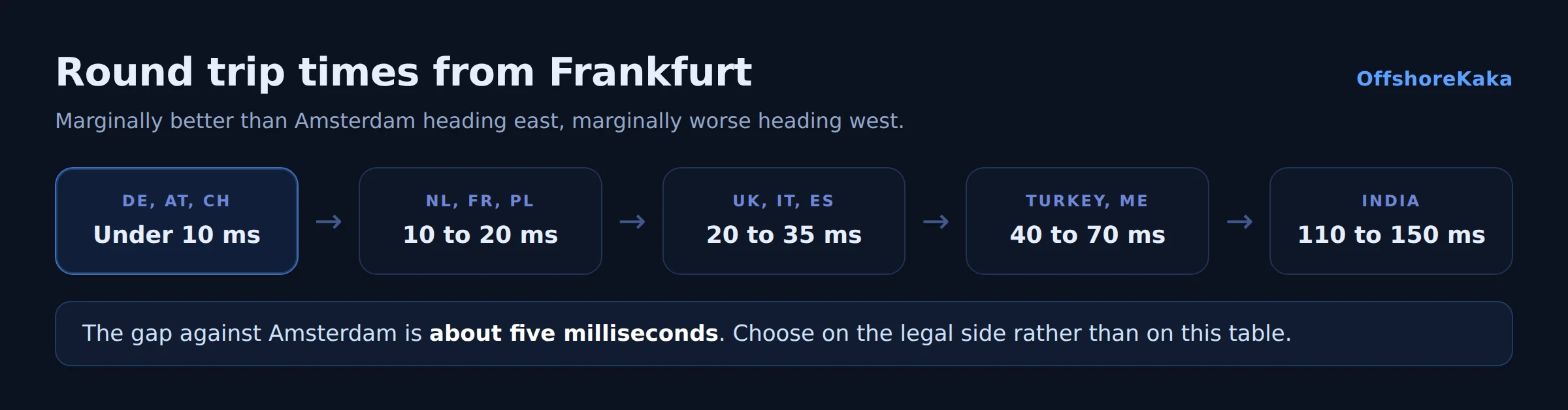
Frankfurt is also more central on the map than Amsterdam. That shows up as marginally better latency toward Central and Eastern Europe, Turkey, the Middle East and onward to Asia. The difference is small, five to fifteen milliseconds depending on destination, but it is free.
Germany also has more hosting capacity than anywhere else in Europe, which means more competition and generally slightly lower prices for the same hardware.
Who it suits
- Businesses handling personal data, particularly B2B where clients ask about data residency.
- Anyone whose priority is privacy law rather than content flexibility.
- Projects serving Central or Eastern Europe, the Middle East, or routing onward to Asia.
- SaaS products with EU customers, where “processed in Germany” is a selling point.
- Anyone who wants the cheapest good European hardware, since German capacity is plentiful.
Latency to expect
| From | Typical round trip |
|---|---|
| Germany, Austria, Switzerland | Under 10 ms |
| Netherlands, France, Poland | 10 to 20 ms |
| UK, Italy, Spain | 20 to 35 ms |
| Turkey, Middle East | 40 to 70 ms |
| US east coast | 85 to 100 ms |
| India | 110 to 150 ms |
As always, put those against what your application costs. An uncached page is routinely 400 milliseconds of server time, which dwarfs every number in that table. Fix caching before worrying about geography.
Where Germany is stricter
Worth being straightforward about the trade off, because it is real.
German law on defamation and on certain categories of speech is more restrictive than Dutch law, and German hosts apply it. Categories that are legal but that many hosts refuse, adult content and gambling being the usual examples, are more commonly accepted in the Netherlands than in Germany.
So if your project sits in a grey area, the Netherlands is the more accommodating of the two. If your priority is data protection for ordinary business content, Germany is the stronger choice. Our side by side comparison goes through this properly.
Checklist
- Datacentre confirmed as Germany, in writing.
- KVM virtualisation confirmed.
- NVMe storage confirmed.
- Your content category checked against German norms.
- Abuse policy read in full.
- Network tested from where your visitors are.
- Console access available in the panel.
Want a server in Frankfurt?
OffshoreKaka runs KVM VPS on AMD EPYC with NVMe in Frankfurt, from 2 cores and 4GB RAM at ₹999/mo, with crypto payments accepted.
FAQ
Is German hosting better for GDPR compliance?
GDPR applies identically across the EU, so technically no. What Germany adds is a stricter enforcement culture and constitutional protection on top, plus the reputational shorthand that makes “hosted in Germany” a satisfying answer when someone asks. For compliance conversations, that shorthand has real value.
Is Germany cheaper than the Netherlands?
Usually slightly, because there is more hosting capacity and more competition there. The gap is small enough that it should not decide your choice on its own.
Can I pay anonymously for German hosting?
Depends on the host rather than the country. Many offshore providers with German nodes accept crypto without identity verification. Remember the account is one link in a chain, and the domain registration and payment trail matter too. See anonymous VPS hosting.
Does German hosting affect my search ranking?
No. Google does not rank by server country. It reads the domain extension, the content language and your Search Console targeting. A German-hosted site aimed at the UK still ranks in the UK. Speed and uptime matter, and those belong to the server rather than the map.