
Offshore Hosting Guides
Unmetered does not mean unlimited
Unmetered means nobody counts the terabytes. It says nothing about how fast those terabytes can move, and speed is the part that actually decides whether your site works during a traffic spike.
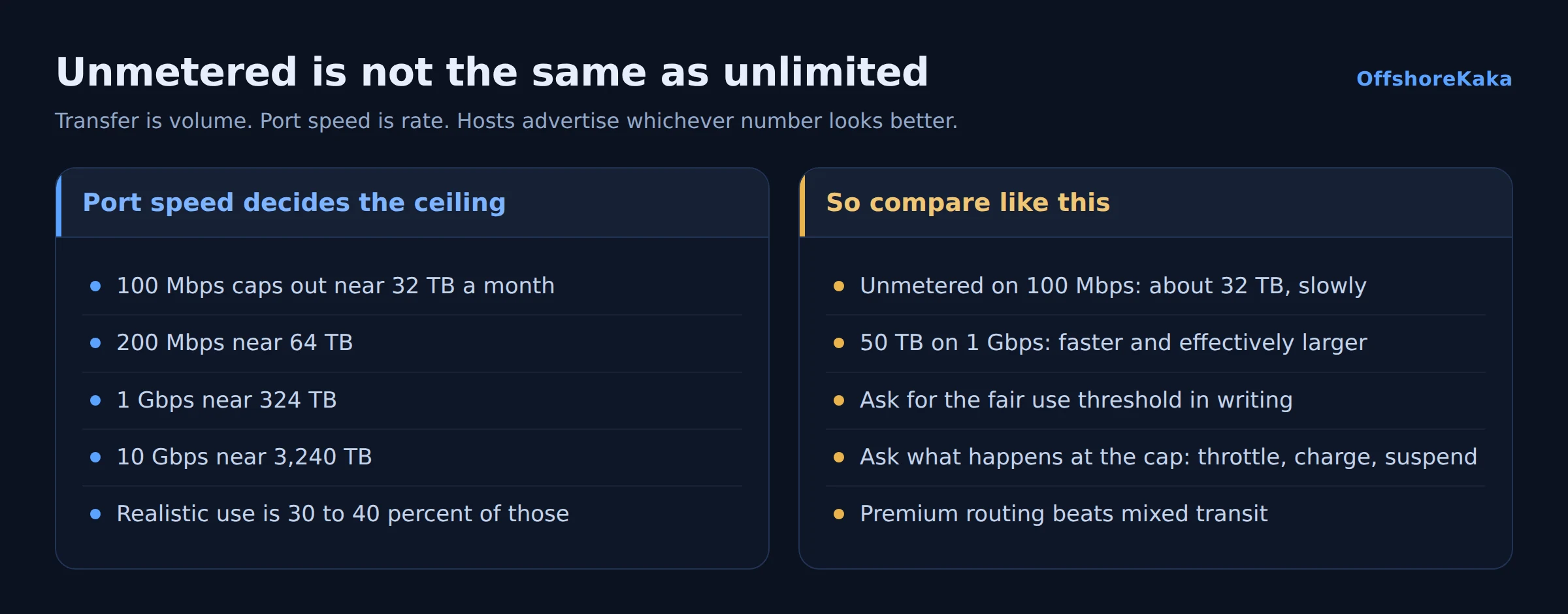
An unmetered 100Mbps port sounds generous and is a hard ceiling of roughly 32TB a month at full tilt. A metered 1Gbps port with 50TB included is a completely different product. Reading these listings correctly is the whole skill.
The two numbers
Transfer is volume: how many terabytes per month. Usually stated as a number of TB, or as unmetered.
Port speed is rate: how fast data can move at any instant. 100Mbps, 1Gbps, 10Gbps.
They are independent, and hosts advertise whichever looks better. A listing that says unmetered without mentioning port speed is telling you half the story, and it is the less useful half.
What a port speed is actually worth
The arithmetic is simple and worth doing once, because it makes the marketing transparent.
| Port speed | Maximum per month at 100 percent | Realistic at 30 to 40 percent |
|---|---|---|
| 100 Mbps | about 32 TB | 10 to 13 TB |
| 200 Mbps | about 64 TB | 20 to 26 TB |
| 1 Gbps | about 324 TB | 100 to 130 TB |
| 10 Gbps | about 3,240 TB | 1,000 TB and up |
Nobody sustains 100 percent for a month, so the right hand column is what you should plan against.
The important consequence: an unmetered 100Mbps port cannot deliver more than about 32TB no matter what the word unmetered implies. If someone offers you unlimited traffic on 100Mbps and a competitor offers 50TB on 1Gbps, the second one is both faster and, in practice, larger.
Words to look out for
- Unmetered. No volume cap. Fine, as long as the port speed is stated.
- Unlimited. Marketing. Every connection has a physical limit. Check the acceptable use policy for the number that actually applies.
- Burstable. You can exceed a base rate briefly. Sounds good, but ask what the base rate is and how long a burst can last, because that is where the real limit hides.
- Fair use policy. The escape hatch. It means unmetered until someone decides you are using too much. Ask what the threshold is and what happens when you cross it.
- Premium versus mixed bandwidth. Premium routes over well peered tier 1 networks. Mixed blends in cheaper transit and can mean worse latency to some regions. This is often the real difference between two similar looking prices.
- 95th percentile billing. Common on larger plans. Your usage is sampled, the top 5 percent of samples are discarded, and you are billed on the rest. It is generous with short spikes and expensive with sustained load.
What you actually need
Most people massively overestimate this. Work it out rather than guessing:
Average page weight, times monthly page views. A 2MB page with 100,000 views is about 200GB. That is nothing; every plan covers it.
- Normal websites and blogs: under 1TB a month. Any plan.
- Busy content sites with images: 1 to 5TB.
- File downloads or software distribution: 10TB and up, and port speed starts to matter.
- Video streaming: tens of TB, and port speed matters more than the allowance.
If you serve large files, port speed is the number that determines your users’ experience. A single user pulling a large file from a 100Mbps port gets a slow download no matter how many terabytes you are allowed.
Also worth knowing: putting a CDN in front moves most of the volume off your server entirely, which often makes the whole question moot. Our TTFB guide covers where a CDN helps and where it does not.
Questions to ask before ordering
- What is the port speed, and is it dedicated or shared?
- If it is unmetered, is there a fair use threshold, and what is the number?
- What happens when I exceed it: throttled, charged, or suspended?
- Is the bandwidth premium or mixed?
- Is billing flat rate or 95th percentile?
- Can I upgrade the port later without moving machines?
Ask these before you pay. The answers are usually reasonable, and the ones who will not answer clearly have told you something too.
Checklist
- Port speed known, not just the transfer allowance.
- The monthly maximum calculated from the port speed.
- Fair use threshold asked about in writing.
- Overage behaviour understood before it happens.
- Premium versus mixed routing confirmed.
- Your real usage estimated from page weight and views.
- CDN considered for anything media heavy.
Want the numbers stated plainly?
OffshoreKaka publishes port speed and traffic on every dedicated plan, on well peered networks in Amsterdam and Frankfurt.
FAQ
Is unmetered better than a large transfer allowance?
Only if the port speed is comparable. Unmetered on 100Mbps caps out around 32TB a month, so 50TB on a 1Gbps port is both faster and effectively larger. Compare the port speeds first and the allowances second.
What happens if I go over a metered limit?
It varies and you need to know in advance. Some hosts throttle to a slower speed, some charge per TB, and some suspend the server. Overage charges can be startling, so ask for the number rather than assuming it is small.
Does bandwidth affect my Google ranking?
Not directly. What matters is whether pages load quickly for visitors, and a saturated port makes them slow. If you are nowhere near your limit, bandwidth has nothing to do with ranking.
Do I need 10Gbps?
Almost certainly not. It matters for video platforms, large file distribution and CDN edge nodes. A normal website will never come close to saturating 1Gbps, and paying for 10 is money that would do more good elsewhere, such as in the memory and disk you actually use.