
Offshore Hosting Guides
Most people upgrade too early
The pitch for a VPS is control, and control sounds obviously better than not having it. In practice a well configured shared plan with caching handles far more traffic than people expect, and a VPS nobody maintains is worse than shared hosting nobody has to.
So the useful question is not which is better. It is whether you have hit a limit that only root access solves.
How each one works
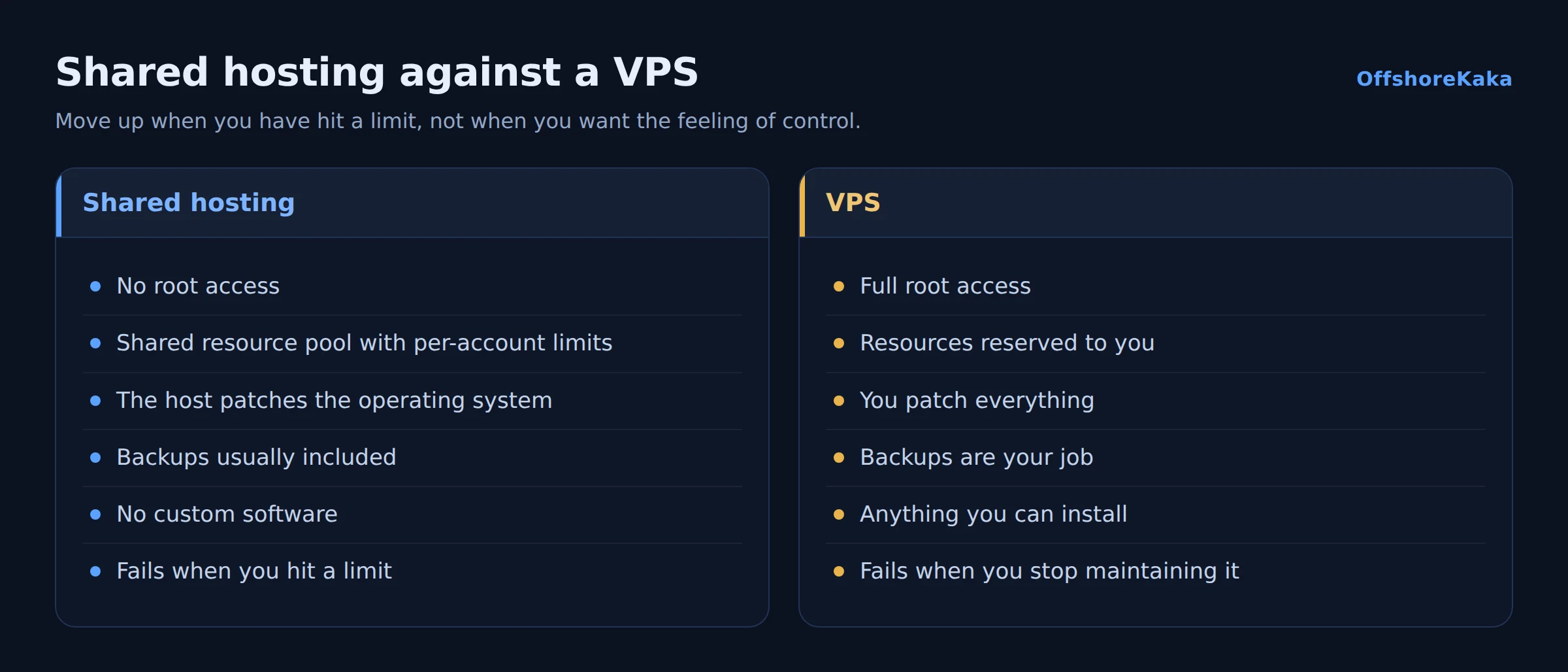
Shared hosting puts many sites on one server, all drawing from one pool of CPU and memory. The host maintains the operating system, patches the stack, and enforces per-account limits so one site cannot take down the rest. You get cPanel and no root access.
A VPS is a virtual machine with its own operating system and a reserved slice of resources. Root access, any software you like, and complete responsibility for keeping it running. Nobody else’s traffic affects you, and nobody else patches your kernel.
Side by side
| Shared hosting | VPS | |
|---|---|---|
| Root access | No | Yes |
| Resources | Shared pool with limits | Reserved to you |
| Neighbours affect you | Sometimes | No, on KVM |
| Who patches the OS | The host | You |
| Who takes backups | Usually the host | You |
| Custom software | No | Anything |
| Skills needed | None | Real Linux, or a panel plus discipline |
| Typical price | Low | Three to ten times more |
| Fails when | You hit a limit | You stop maintaining it |
Signs you have genuinely outgrown shared
- Your host has told you. They see the resource usage. If they are asking you to upgrade, they are usually right.
- You are hitting CPU or entry process limits during normal traffic, and the panel’s resource graphs show it repeatedly rather than once.
- You need software the host will not install. Redis, a Node runtime, a specific PHP extension, a queue worker.
- You need a background process that runs continuously. Shared hosting kills long running processes by design.
- You need your own mail IP. On shared hosting your sending reputation is shared with everyone else on the IP.
- You host client sites and need isolation and your own nameservers.
Reasons that are not good enough
These come up constantly and none of them is solved by a VPS.
- “My site is slow.” Usually caching, page weight or a heavy plugin. Moving an uncached site to a VPS gives you an uncached site on a VPS. Measure first, with our TTFB guide.
- “I want more security.” A VPS is only as secure as you make it, and an unmaintained one is far less secure than managed shared hosting. Root access is a responsibility, not a security feature.
- “I have a lot of traffic.” Depends entirely on whether it is cached. A cached WordPress site serves a lot of traffic from very little hardware.
- “It sounds more professional.” Nobody can tell from the outside.
The real cost
The price difference is the visible part. The rest is time.
A VPS needs security updates, a firewall, SSH hardening, backups you have actually tested, and monitoring so you find out about a full disk before your visitors do. That is a couple of hours to set up and perhaps thirty minutes a month afterwards, assuming nothing goes wrong.
When something does go wrong, it is yours. A shared host has staff watching the machine at 3am. On a VPS, that is you.
If that trade sounds fine, a VPS is a good move. If it sounds like a chore you will skip, it is not, and that is a perfectly reasonable conclusion. Our security checklist is a fair preview of the ongoing commitment.
Deciding
- Have you hit a documented limit, or does it just feel slow?
- Have you tried caching first?
- Do you need software the host will not install?
- Will you actually run updates every week?
- Do you have somewhere to put backups?
- Does the provider give you a console for when you lock yourself out?
Ready either way?
OffshoreKaka runs both: LiteSpeed shared hosting with cPanel, and KVM VPS servers with full root, all in Amsterdam and Frankfurt.
FAQ
Is a VPS faster than shared hosting?
Not automatically. A shared plan running LiteSpeed with LSCache often beats a carelessly configured VPS, because a cached page is fast regardless of the hardware under it. What a VPS gives you is consistency rather than raw speed.
Can I move back down later?
Yes. Migrating from a VPS to shared hosting is the same work in reverse, and there is no penalty for it. If a VPS turns out to be more maintenance than you wanted, moving back is a normal thing to do.
What about managed VPS?
It is the middle ground: reserved resources with the provider handling patching and monitoring. It costs more than unmanaged and less than the time you would spend doing it yourself. Worth pricing if you need the resources but not the responsibility.
Does either help my Google ranking?
Only through speed and uptime, and both are configuration rather than plan type. Google does not know or care what you are hosted on. Fix caching before you consider changing plan.