
Locations
Why Amsterdam keeps coming up
Amsterdam has been a European internet crossroads since the 1990s, and AMS-IX is still one of the largest exchange points anywhere. A very large number of networks peer directly there, which means traffic leaving Amsterdam usually takes fewer hops to reach the rest of Europe, and routing onward to North America and Asia is unusually good too.
Add Dutch law, which handles hosting complaints through a defined process rather than on receipt of an angry email, and you have the reason most European offshore hosting ends up in the Netherlands.
The network case
Peering is the thing people underrate. When two networks peer directly, traffic between them does not have to travel through a third party’s transit, which means fewer hops, lower latency and fewer places for something to go wrong.
AMS-IX has hundreds of connected networks. Practically, a server in Amsterdam has short, direct paths to most European ISPs, and good onward routes to the UK, the US east coast and beyond. You do not have to do anything to benefit from this; it comes with the location.
The other consequence is redundancy. A city with that much interconnection has many possible routes, so a single upstream problem is much less likely to make your server unreachable.
The legal case
Two things matter here and they are separate.
Data protection. The Netherlands is in the EU and GDPR applies. If your clients ask where their data lives, an EU answer is the easy one to give, and you can write it in a privacy policy without qualification.
How complaints are handled. This is the one that decides whether offshore hosting was worth it. The Netherlands operates a notice and takedown framework that most serious hosts follow. It is a process: a properly formed legal notice gets acted on, and an unsupported complaint does not automatically take your site offline while somebody investigates.
For a business brochure site this never comes up. For a forum, a review site, a news site, or anything where visitors post content, it is the entire reason to be here. One bad-faith complaint should not cost you a week of downtime.
Dutch content tolerance is also broader than Germany’s for categories that are legal but that mainstream hosts refuse. Our Netherlands versus Germany comparison covers where the two differ.
Who it suits
- Sites with user generated content. Forums, communities, classifieds, review platforms.
- Publishers and journalists who need takedowns to require more than an email.
- Anyone with a European audience, where this is purely a latency decision.
- Businesses needing EU data residency, often because a client asked.
- Projects in legal but unwelcome categories that mainstream hosts prohibit by policy.
Who it does not suit: a business whose customers are all in one distant country. If your audience is entirely in South Asia or the Americas, host closer to them. That is straightforward physics, not a policy question.
What latency to expect
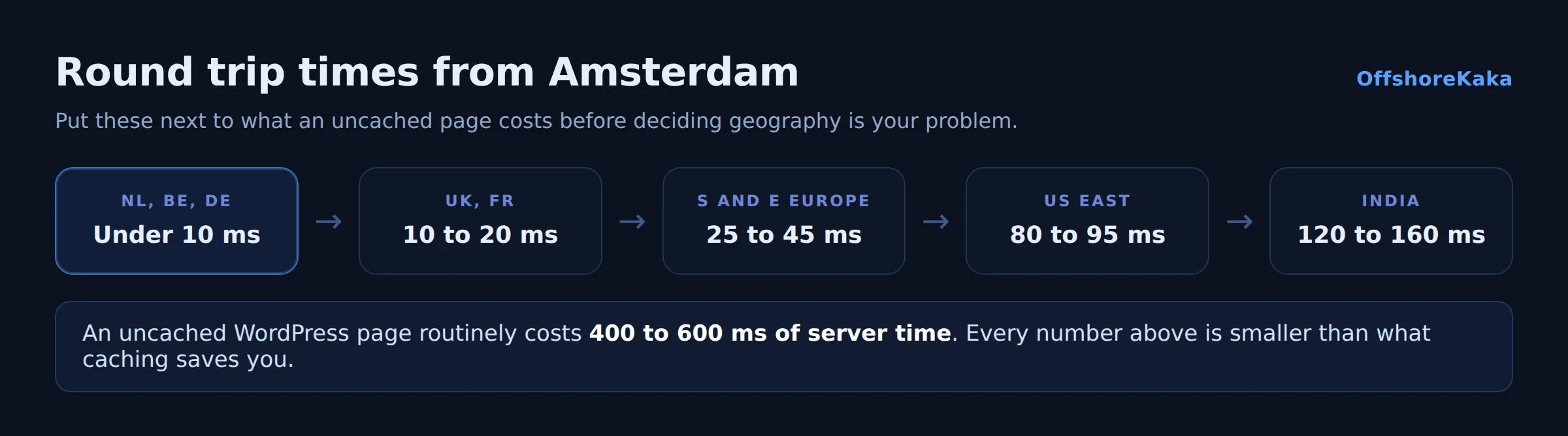
Rough round trip times from Amsterdam, useful for setting expectations:
| From | Typical round trip |
|---|---|
| Netherlands, Belgium, Germany | Under 10 ms |
| UK, France | 10 to 20 ms |
| Southern and Eastern Europe | 25 to 45 ms |
| US east coast | 80 to 95 ms |
| India | 120 to 160 ms |
| Singapore | 160 to 190 ms |
Keep those in proportion. An uncached WordPress page routinely costs 400 to 600 milliseconds of server time. Even the worst number in that table is smaller than what caching saves you. Our TTFB guide shows how to see the split for your own site.
What to insist on
- KVM virtualisation, so memory is reserved rather than oversold.
- NVMe storage. Ask explicitly; SSD in a listing can mean SATA.
- The actual datacentre, not the company’s registered address. Plenty of hosts are registered in one country and rent racks in another.
- The abuse policy, read in full, since that is the document that matters on your worst day.
- A console in the panel, for when a firewall rule locks you out.
Checklist
- Datacentre location confirmed as Netherlands, in writing.
- KVM confirmed.
- NVMe confirmed.
- Abuse and takedown policy read.
- Network tested from where your visitors are.
- Console access available.
- Backups arranged before go-live.
Want a server in Amsterdam?
OffshoreKaka runs KVM VPS on AMD EPYC with NVMe in Amsterdam, from 2 cores and 4GB RAM at ₹999/mo, online in about a minute.
FAQ
Is a Dutch VPS good for an audience outside Europe?
Workable rather than ideal. Amsterdam has excellent onward routing, so it is usually a better long distance host than a poorly connected local one. But if all your visitors are in one distant country, a server near them will be faster. Use a CDN and caching either way.
Does Dutch hosting ignore DMCA notices?
DMCA is a United States statute and has no direct force in the Netherlands, so a bulk automated notice does not automatically remove content. That is not the same as copyright not applying. The EU has its own copyright framework and a properly formed claim under it is enforceable. More on this in is offshore hosting legal.
Can I pay anonymously?
With many Dutch offshore hosts, yes, including crypto without identity verification. Remember the hosting account is one link in a chain: the domain registration and the payment trail matter as much. Our guide to anonymous VPS hosting covers the whole chain.
Netherlands or Germany?
Netherlands for user generated content and broader category tolerance. Germany for the strictest privacy law and marginally better routing eastward. The difference in latency is about five milliseconds, so decide on the legal side rather than the network side.