
Offshore Hosting Guides
Two good answers, small differences
Amsterdam and Frankfurt are the two best places in Europe to put a server, and honestly the gap between them is narrow. Both sit on top of a major internet exchange, both are inside the EU and under GDPR, and both have serious constitutional privacy protection.
So this is not a case of one being right. It is a case of a few specific differences that tip the decision depending on what you host and who reads it.
The Netherlands
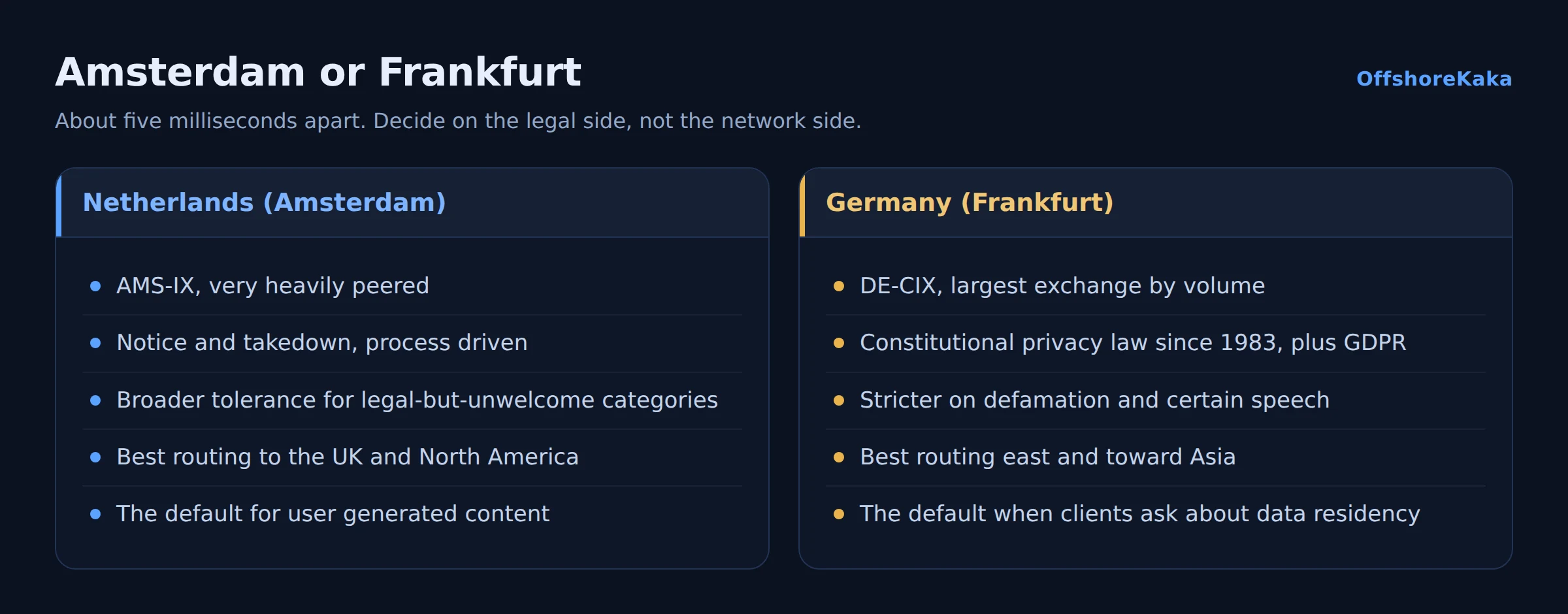
Amsterdam has been a European internet hub since the early days, and AMS-IX is one of the largest exchanges in the world. Practically, that means an unusually large number of networks peer directly there, so traffic from Amsterdam often takes fewer hops to reach the rest of Europe, and routing to North America and Asia is good too.
Dutch hosting law is where the real difference sits. The Netherlands has a well established notice and takedown framework that most serious hosts follow, and it is process driven rather than complaint driven. A properly formed legal notice gets acted on; an angry email generally does not.
Content tolerance is broader than Germany’s. Categories that are legal but that many hosts refuse, adult content and gambling being the usual examples, are more commonly accepted by Dutch providers, within Dutch law.
The Netherlands is also the practical default for anyone hosting user generated content, because complaint-driven suspension is the risk that actually hurts a forum or a community site.
Germany
Germany has the strictest data protection culture in Europe, and that is not just GDPR. The German constitution has been read as protecting informational self determination since a 1983 court ruling, decades before GDPR existed. In practice, German hosts and German courts take data requests seriously and slowly, which is the point.
DE-CIX in Frankfurt carries more traffic than any other exchange in the world by most measures. Frankfurt is also more central on the map than Amsterdam, so it is marginally better positioned for Eastern Europe, the Middle East and onward routing to Asia.
The trade off is that German hosting rules around content are tighter. German law on defamation, and on certain categories of speech, is more restrictive than Dutch law, and hosts apply that. If you host anything in a grey area, Germany is the stricter of the two.
Germany also tends to be marginally cheaper, because there is more hosting capacity and more competition there than anywhere else in Europe.
Side by side
| Netherlands (Amsterdam) | Germany (Frankfurt) | |
|---|---|---|
| Exchange | AMS-IX | DE-CIX, largest by volume |
| Privacy law | Strong, GDPR | Strongest in Europe, GDPR plus constitutional |
| Takedown process | Notice and takedown, process driven | Process driven, stricter on content |
| Content tolerance | Broader | Narrower |
| Best for | User content, forums, broader categories | Business data, EU compliance, privacy first |
| Routing strength | Western Europe, UK, North America | Central and Eastern Europe, Middle East, Asia |
| Typical price | Slightly higher | Slightly lower |
How to actually choose
Work through these in order and you will usually have an answer by the second one.
- Where are your visitors? Western Europe or the UK, lean Amsterdam. Central or Eastern Europe, the Middle East or Asia, lean Frankfurt. The difference is small, but it is free.
- What do you host? Anything with user submissions, or in a category some hosts refuse, points to the Netherlands. Business data and anything where you will be asked about GDPR compliance points to Germany.
- Who are you answering to? If clients or auditors ask where data is stored, Germany is the easier answer to give. It is recognised as the strict one.
- Is price the deciding factor? Then Frankfurt, marginally.
Do not choose on latency alone. The difference between the two cities is about five milliseconds, which is far less than what your caching configuration is worth. Our TTFB guide covers where the time actually goes.
Moving later
Neither choice locks you in. Moving between two European datacentres is the same work as any other migration: copy files and database, test on the new server, lower your TTL a day ahead, then switch DNS. The latency change is small enough that visitors will not notice.
What you should get right the first time is the hosting type, since moving from shared to VPS means learning to run a server. Our guide to choosing VPS specs covers that side.
Decision checklist
- Audience location identified.
- Content category checked against each country’s norms.
- Compliance requirements considered, if you have clients who ask.
- Datacentre confirmed, not just the company’s address.
- Network tested from where your visitors are.
- Abuse policy read for the specific host, not just the country.
Want both options?
OffshoreKaka runs nodes in Amsterdam and Frankfurt, so you can pick the jurisdiction that suits your project and move between them later if it changes.
FAQ
Which one is faster?
For practical purposes, neither. They are about 5ms apart and both have excellent onward routing. Frankfurt is marginally better toward the east, Amsterdam marginally better toward the UK and North America. Your caching setup will change the number far more than the city does.
Which is better for privacy?
Germany, slightly, because of the constitutional layer on top of GDPR. Both are far ahead of most of the world. If privacy is the single reason you are going offshore, Germany is the safer pick.
Does either help my Google ranking?
No. Server country is not a ranking factor. Google reads the domain extension, the content language, and your Search Console targeting. A German-hosted site aimed at the UK still ranks in the UK. Speed and uptime matter and both come from the server, not the country.
Can I split, with a site in one and backups in the other?
Yes, and it is a sensible pattern. Keeping backups in a different country and with a different provider means a problem with one does not take out both. Our backup guide covers doing it properly.