
Offshore Hosting Guides
The short version
Offshore hosting means your website lives on a server in a country other than your own, chosen deliberately for its laws rather than for its geography. Nothing about the technology is different. It is the same Linux, the same cPanel, the same WordPress. What changes is which country’s rules apply to the machine.
That is the whole idea. Everything else on this page is about which country, which type of hosting, and what to check before you pay anyone.
Why people choose it
The word offshore carries a lot of baggage it does not deserve. In hosting it means one thing: you picked the country on purpose. Here is who does that and why.
- Privacy. The Netherlands and Germany both have strong constitutional data protection and operate under GDPR. Your registration details are not casually handed over, and there is a legal process rather than an email.
- Predictable takedown rules. Some countries let anyone file a complaint and have content pulled within hours, with the appeal happening afterwards if at all. European hosts generally require a court order. For journalists, forums and anyone hosting user content, that difference is the entire point.
- Payment options. Many offshore hosts accept crypto and do not require full identity verification, which matters to people who have legitimate reasons not to attach their legal name to a server.
- Audience location. Sometimes it is just geography. A server in Amsterdam serves European visitors faster than one in Mumbai does, and that is a plain performance decision.
What offshore hosting is not is a shield against the law. If content is illegal where you are, hosting it elsewhere does not make it legal, and it does not stop a court in your own country from having something to say about it. There is a fuller treatment in is offshore hosting legal.
The three types
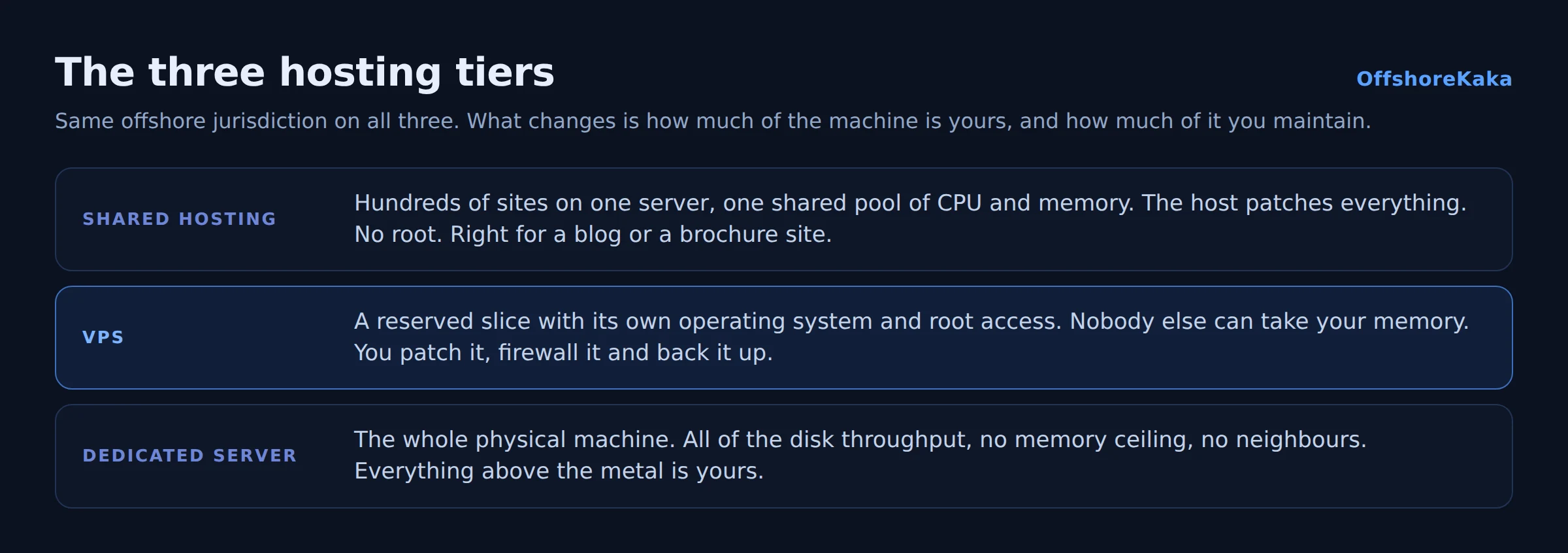
Same three tiers as any other hosting. The offshore part is orthogonal to this choice.
Shared web hosting. Your site sits alongside others on one server, managed through cPanel. Cheapest, easiest, and the right answer for a blog, a portfolio or a business brochure site. You do not touch a command line.
VPS. A slice of a server that is yours alone, with root access and guaranteed CPU and memory. You install and maintain everything. The right answer when you need a specific stack, when you have outgrown shared limits, or when you want isolation from other tenants. Explained further in what is offshore VPS hosting.
Dedicated server. The entire physical machine. Nobody else on it at all. Right for heavy sustained load, large databases, or anything where you need to know exactly what hardware you are on. See offshore dedicated servers.
Most people over-buy here. A WordPress site with caching turned on runs perfectly well on shared hosting, and a VPS you do not know how to maintain is worse than shared hosting you never have to think about.
Where to host
For most people the honest answer is the Netherlands or Germany. Both are inside the EU, both have serious privacy law, and both sit on top of the two biggest internet exchanges in Europe, AMS-IX in Amsterdam and DE-CIX in Frankfurt. That means genuinely good routing to most of the world, not just to Europe.
Other jurisdictions get advertised as more permissive. Be careful there. Extremely permissive usually correlates with worse network quality, worse support, and neighbours whose activity gets the whole IP range blocklisted. A quiet European datacentre with a clear abuse policy is a better home for a real business.
The choice between the two countries is smaller than people expect, and we went through it properly in Netherlands versus Germany.
What to check before buying
Hosting reviews mostly compare prices. These are the things that actually determine whether you are happy in six months.
- Where is the datacentre, exactly? Not the company’s registered address. Ask for the facility. A host registered in one country routinely rents space in another.
- What is the takedown policy? Read it. Does a complaint email get your site suspended, or does it need a court order? This is the single most important document and almost nobody reads it.
- NVMe or spinning disks? On a database driven site the difference is not subtle. Ask if the plan does not say.
- Are backups included, and can you restore one yourself? Included backups that require a support ticket at 2am are not the same as backups you control.
- Is there a real person on support? Send a technical question before you buy and see what comes back and how fast.
- What happens at renewal? Introductory pricing that triples in year two is standard in this industry.
Common mistakes
- Buying a VPS to save money and not maintaining it. An unpatched VPS gets compromised, and then you have a hacked site and a hosting bill. If you are not going to run updates, buy shared hosting.
- Assuming offshore means anonymous to everyone. It means your host does not casually publish your details. Your domain registrar, your payment method and your own content still say plenty about you.
- Picking on price alone. The cheapest offshore plans are usually oversold shared boxes where one noisy neighbour slows everyone down.
- Not testing the network before committing. Ask for a test IP and run a traceroute from where your visitors actually are.
Moving an existing site
Migrating is routine and does not cost you rankings, as long as the URLs stay the same and the site does not go down during the switch. The sequence is: copy everything to the new server, test it there before touching DNS, lower your TTL a day ahead, then switch. Our WordPress migration guide covers the detail.
Buyer checklist
- Datacentre location confirmed, not just the company address.
- Takedown and abuse policy read in full.
- Hosting type matched to what you will actually maintain.
- NVMe storage confirmed.
- Backups included and self-service.
- Support tested with a real question before paying.
- Renewal price checked, not just the first term.
- Network tested from where your visitors are.
Looking at offshore hosting?
OffshoreKaka runs shared hosting, KVM VPS and bare metal in Amsterdam and Frankfurt, with crypto payments accepted and a clear abuse policy you can read before you buy.
FAQ
Is offshore hosting legal?
Yes. Choosing which country your server sits in is a normal business decision, and companies do it constantly for latency, cost and compliance reasons. What stays illegal is illegal content, and moving it abroad does not change that.
Will it slow my site down?
Only by the distance involved, which is tens of milliseconds, not hundreds. A well configured server in Amsterdam is faster for a European audience than a badly configured one nearby. Caching matters far more than distance, as our TTFB guide shows.
Does offshore hosting hurt my Google ranking?
No. Google does not rank by server country. It uses the domain extension, the language, and any country targeting you set in Search Console. A .co.uk site hosted in Amsterdam still ranks in the UK. Speed and uptime matter, and both are about the server itself rather than the country.
Can I pay without giving my identity?
With many offshore hosts, yes. Bitcoin and other cryptocurrencies are widely accepted and full identity verification is often not required. You still need a working email address for account recovery, and you should keep those credentials somewhere safe, because a lost password on an anonymous account is genuinely hard to recover.