
Comparison
Two different answers to the same question
Shinjiru is one of the oldest names in offshore hosting. Malaysian company, in business since 1998, eight datacentre locations, and a long track record with clients who need a permissive host.
OffshoreKaka is smaller and focused: KVM VPS, shared hosting, reseller and dedicated servers in two European locations, Amsterdam and Frankfurt. That focus is the whole difference, and it makes each of us right for a different kind of project. We will be straight about which is which.
Side by side
| OffshoreKaka | Shinjiru | |
|---|---|---|
| Company base | Focused on EU hosting | Malaysia, trading since 1998 |
| Locations | Amsterdam, Frankfurt | Eight, including Malaysia and the Netherlands |
| Virtualisation | KVM on all VPS plans | Varies by product line |
| Storage | Pure NVMe | Varies by plan |
| EU data residency | Always, both locations | Available on the Netherlands nodes |
| Crypto payment | Yes, no identity verification | Yes |
| Product range | Shared, VPS, reseller, dedicated | Broader, including colocation |
| Entry VPS | 2 cores, 4GB, 40GB NVMe, ₹999/mo | Varies by location |
Specifications and pricing change. Check both directly before deciding rather than trusting any comparison table, including this one.
Pick Shinjiru if
We would genuinely point you there in these cases.
- You need a jurisdiction outside Europe. Their Malaysian location is outside EU legal reach entirely, which is a different proposition from EU hosting and the right one for some projects.
- Your audience is in Southeast Asia. A server in Kuala Lumpur will serve Malaysian, Singaporean and Indonesian visitors faster than anything in Europe can.
- You want the longest track record available. Nearly thirty years in this niche is a real thing, and there is no substitute for it.
- You need colocation or a product we do not offer. Their range is wider.
- You want several jurisdictions with one provider, for redundancy across legal environments as well as across hardware.
Pick OffshoreKaka if
- Your audience is European. Amsterdam and Frankfurt sit on AMS-IX and DE-CIX, which is as close to the middle of the European internet as you can get.
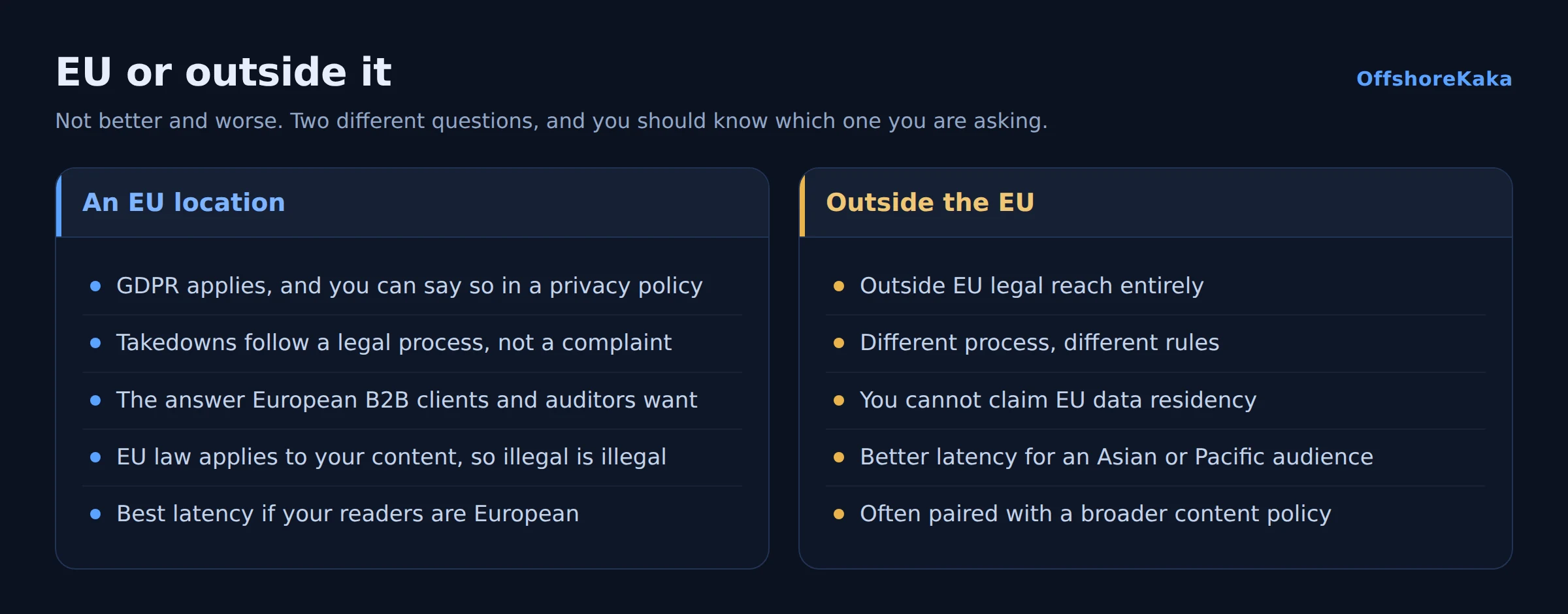
- You need EU data residency you can point to. Both our locations are in the EU under GDPR, which is the answer B2B clients and auditors want.
- You want KVM on every plan, with memory that is reserved rather than oversold. No container tiers, no exceptions.
- You want NVMe as standard rather than as an upgrade on some plans.
- You want a small provider where support is a person. That cuts both ways and we will come back to it.
The jurisdiction question
This is the real decision and it is worth thinking about properly rather than picking on features.
EU hosting means GDPR, strong data protection, and takedowns that follow a legal process rather than a complaint. It also means EU law applies to your content, so anything illegal in the EU is a problem in the EU.
Non-EU hosting in a jurisdiction like Malaysia is outside EU legal reach. Different rules, different process, and for some projects that is precisely the point. It also means you cannot tell a European client their data is processed in the EU, which for a B2B business is often a dealbreaker.
Neither is better. They answer different questions. Work out which question you are asking before you compare specifications. Our guide to the legal side of offshore hosting covers what jurisdiction does and does not do.
Network and latency
Straightforward physics. From Amsterdam or Frankfurt, European visitors see round trips under 30 milliseconds and US east coast around 90. From Kuala Lumpur, Southeast Asian visitors see under 20 and European visitors see 150 to 200.
Host near your readers. If they are split, use a CDN for static files and accept that the HTML has to come from one place. And remember that caching configuration usually moves the number further than geography does, as our TTFB guide shows.
Being honest about size
We are the smaller company. That means faster, more personal support and someone who actually reads your ticket. It also means fewer datacentre locations, a narrower product range, and less institutional history than a provider approaching three decades in business.
If breadth of locations and length of track record are what you are buying, that is a fair reason to choose the larger provider, and we would rather say so than pretend otherwise.
How to decide
- Where are your visitors? Host near them.
- Do you need EU data residency, or specifically to be outside the EU?
- Is KVM confirmed on the exact plan you are looking at?
- Is the storage NVMe on that plan?
- Read both abuse policies in full.
- Send both a technical question before paying and compare the replies.
If EU is what you need
OffshoreKaka runs KVM VPS with NVMe in Amsterdam and Frankfurt, full root, crypto accepted, online in about a minute.
FAQ
Which one is better?
Neither, in the abstract. Shinjiru is better if you need a non-EU jurisdiction, an Asian audience, or a product range we do not carry. We are better if you want EU data residency, European latency, and KVM with NVMe as standard rather than as options.
Which for privacy inside the EU?
For EU privacy specifically, an EU location is the requirement, and both companies can provide one since Shinjiru also has Netherlands nodes. Compare on the specifics of the plan: virtualisation type, storage, and what the abuse policy actually says.
Can I pay with cryptocurrency?
Both accept crypto. Ours does not require identity verification. Bear in mind crypto payment is one link in a chain, and the domain registration matters as much, as covered in anonymous VPS hosting.
Can I start small and scale?
With us, yes: plans run from 2 cores and 4GB up to 10 vCPU and 64GB, and you can move up without rebuilding. Check the same with any provider before committing, since some require a migration to change plan.