
Offshore Hosting Guides
Who this is actually for
The reputation of offshore hosting is stuck about ten years behind reality. The people buying it today are mostly businesses, developers and publishers who made a deliberate choice about jurisdiction, not people hiding from anyone.
Here is who genuinely benefits, and, just as usefully, who does not and should save the trouble.
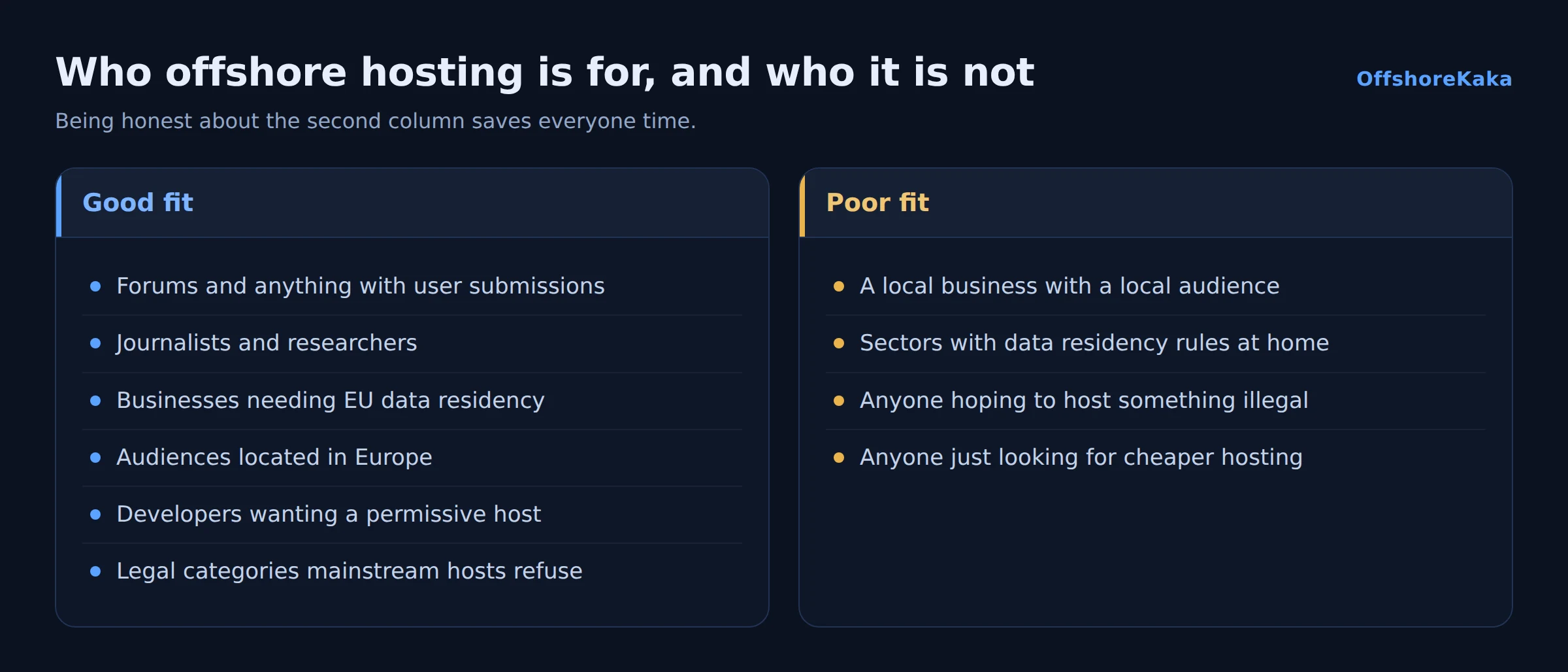
Six use cases that make sense
1. Sites with user generated content
Forums, communities, review sites, anything where visitors post. The risk here is not hackers, it is a bad-faith complaint about something a user wrote getting the whole site suspended while someone investigates. A host that requires a court order rather than an email changes the shape of that risk entirely.
2. Journalists, researchers and campaigners
If you publish things that some people would prefer removed, the takedown process is your single biggest operational risk. European hosts working under a proper notice framework are far more predictable than hosts that suspend first and ask later.
3. Businesses that need EU data protection
If your clients ask where their data is stored, hosting in Germany or the Netherlands is a clean answer. GDPR applies, the physical machine is in the EU, and you can say so in your privacy policy without qualification. This comes up far more often in B2B than people expect.
4. Anyone whose audience is in Europe
Sometimes it is purely geography. If most of your readers are in Europe, a server in Amsterdam or Frankfurt is the closest you can get to them, and the word offshore is beside the point. This is just latency.
5. Developers and agencies
Root access, no arbitrary restrictions on what you install, and a host that will not suspend an account because an automated scan misread something. Agencies also often want servers separate from client jurisdictions for cleaner separation.
6. Legal but unwelcome content categories
Adult content, gambling, cryptocurrency projects, file sharing tools, political material. All legal in most of Europe, all routinely prohibited by mainstream hosts’ acceptable use policies. Offshore hosts more often allow them, within local law.
Who does not need it
Being honest about this is more useful than selling to everyone.
- A local business with a local audience. A restaurant in Delhi wants a server near Delhi. Nothing about jurisdiction helps, and the latency is worse.
- An ecommerce store bound by local data rules. Some sectors and some countries have data residency requirements. Check before you move.
- Anyone hoping to host something illegal. It does not work, as covered in is offshore hosting legal, and it ends with a lost server.
- Someone who just wants cheap hosting. Offshore is not cheaper. Price it on merit.
Which type to buy
The jurisdiction question is separate from the hosting type question, and people conflate them.
- Shared hosting for a blog, a portfolio, a brochure site, or a small forum. cPanel, no maintenance, cheapest.
- VPS when you need root, a custom stack, guaranteed resources, or you have outgrown shared limits. You maintain it. See what offshore VPS hosting is.
- Dedicated for heavy sustained load or large databases, where you want the whole machine.
The most common mistake is buying a VPS for the sense of control and then not maintaining it. An unpatched VPS gets compromised, which is worse than shared hosting you never think about.
What to check before buying
- The abuse policy, in full. It defines what happens on your worst day.
- What triggers a suspension: a complaint, or a court order.
- The actual datacentre, not the company’s registered address.
- Network quality from where your visitors are. Ask for a test IP.
- Blocklist status of the IP range, if you will send mail.
- Backups, and whether you can restore one yourself.
- Support, tested with a real question before you pay.
Quick self-check
- Does your content come from users? Offshore helps.
- Is your audience in Europe? Offshore helps.
- Do clients ask where data lives? Offshore helps.
- Is your host’s content policy a problem for you? Offshore helps.
- Is your audience local and your content uncontroversial? Stay where you are.
Think it fits?
OffshoreKaka runs shared hosting, VPS and dedicated servers in Amsterdam and Frankfurt, with a published abuse policy and crypto payments.
FAQ
Is offshore hosting only for adult or piracy sites?
No, and that has not been true for a long time. Most customers are ordinary businesses and publishers who wanted a specific legal environment or a European location. The category has the reputation of its worst 2014 customers.
Will it slow my site for local visitors?
If your visitors are far from the server, yes, by the distance involved. That is usually 100 to 150 milliseconds from Europe to South Asia, which is real but smaller than what an uncached page costs. If your audience is genuinely local, host locally. Our TTFB guide explains where the time goes.
Do I need technical skills?
Not for shared hosting. It is cPanel, the same as anywhere else. A VPS needs real Linux skills, or a control panel and a willingness to keep it updated.
Does it help my Google ranking?
No. Server country is not a ranking factor. Google uses the domain extension, the language and your Search Console targeting. Speed and uptime matter, and those come from the server rather than the country.