
Offshore Hosting Guides
Yes, and here is the actual answer
Choosing which country your server sits in is a normal business decision. Every large company does it, constantly, for latency and cost and compliance reasons. Nobody calls it offshore when Amazon puts your data in Ireland.
What people are really asking is a different question: does hosting abroad let me do things I otherwise could not? Mostly no. This page is about where the line actually sits.
Why it is legal
There is no law anywhere that says a website must be hosted in the owner’s country. Hosting is a service you buy, like a bank account or an accountant, and you are free to buy it from a supplier abroad.
The server is subject to the law of the country it sits in. A server in Frankfurt follows German and EU law. That is not a loophole, that is simply how jurisdiction works, and it applies to every server everywhere.
The confusion comes from the word. Offshore in finance suggests tax avoidance. Offshore in hosting just means the datacentre is in a different country from you, and it is chosen on purpose rather than by default.
What it does not do
This is the part that matters, and it is where people get themselves in trouble by assuming otherwise.
- It does not make illegal content legal. If something is a crime where you live, hosting it abroad does not change that. You are still where you are, and your own country’s law still applies to you personally.
- It does not make you untraceable. Your domain registrar has your details. Your payment left a trail unless it genuinely did not. Your writing style, your other accounts and your own posts all say things. Hosting is one link in a long chain.
- It does not block legal process. European hosts respond to court orders. The bar is higher than a complaint email, which is the actual benefit, but it is a bar rather than a wall.
- It does not stop copyright claims entirely. Many offshore hosts do not act on a bare DMCA notice, since DMCA is US law and does not apply in the EU. But the EU has its own copyright framework, and a properly formed claim under it is enforceable.
Myths worth killing
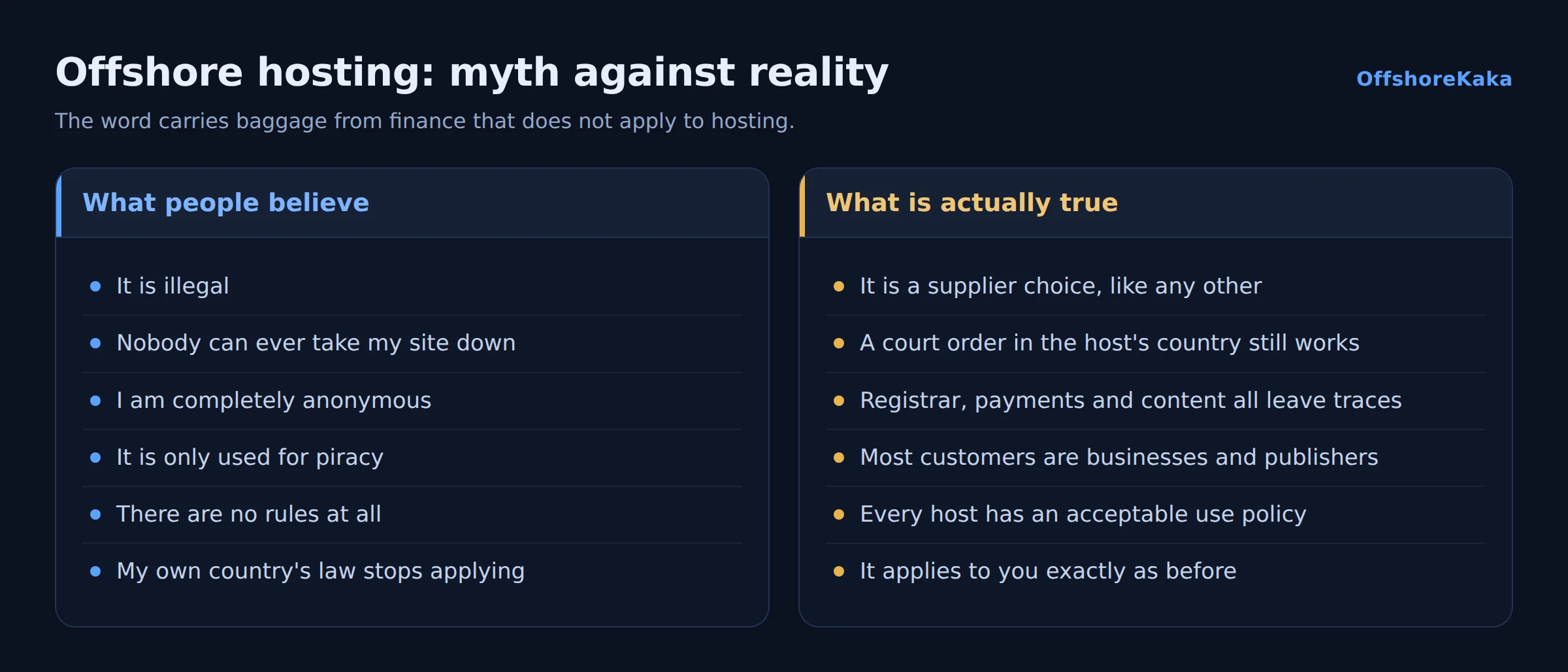
| The myth | The reality |
|---|---|
| Offshore hosting is illegal | It is not. It is a supplier choice, like any other |
| Nobody can ever take my site down | A court order in the host’s country still works |
| I am completely anonymous | Your registrar, your payments and your content all leave traces |
| It is only for piracy | Most customers are businesses, developers and privacy-conscious owners |
| It means no rules at all | Every host has an acceptable use policy. Read it |
| My own country’s law no longer applies to me | It absolutely does. You did not move, your server did |
Why ordinary people use it
The typical customer is not who the reputation suggests.
- Journalists and researchers who publish things powerful people would rather have removed, and who need a complaint alone not to be enough.
- Forums and communities where users post the content. One bad-faith complaint should not take the whole site offline while someone investigates.
- Businesses that want EU data protection, often because their own clients ask where data is stored.
- Developers who want a host that will not suspend an account because an automated scan flagged something odd.
- People with an audience in Europe, for whom this is purely a latency decision and the word offshore is incidental.
There is a fuller breakdown in who should use offshore hosting.
When it does become a problem
To be direct about it, offshore hosting stops helping and starts hurting when:
- The content is illegal in the host’s country too, in which case the host will act and you lose the server and the data.
- You are in your own country doing something your own country prohibits. The server’s location is irrelevant to your personal position.
- You picked a host on the basis that it ignores everything. Those hosts also tend to ignore abuse from their other customers, which means shared IP ranges get blocklisted and your legitimate mail stops being delivered.
The last one is the practical trap. A host with no standards at all is a bad neighbourhood, and you inherit its reputation.
Before you buy
- Confirm your content is legal in the host’s country, not just tolerated.
- Read the acceptable use policy in full.
- Check what actually triggers a suspension: a complaint, or a court order.
- Confirm the real datacentre location.
- Check the IP range is not already on major blocklists.
- Keep your own backups, so a dispute never costs you the data.
Want a host with clear rules?
OffshoreKaka publishes its acceptable use policy up front, hosts in the Netherlands and Germany under EU law, and accepts crypto without demanding your identity.
FAQ
Do I have to tell anyone my site is hosted abroad?
Not as a general rule. If you handle personal data of EU residents, GDPR requires you to say where data is processed in your privacy policy, and hosting in the EU makes that an easy sentence to write. Some regulated industries have their own data residency rules, so check if you are in one.
Does offshore hosting ignore DMCA notices?
Many do, because DMCA is a US statute with no force in the EU. That does not mean copyright does not apply. The EU has its own copyright directive and a properly formed claim under it is enforceable. What changes is that an automated bulk notice does not automatically remove your content.
Is my data safer offshore?
In the Netherlands or Germany, generally yes, because both have stronger data protection law than most of the world. But no jurisdiction protects you from a weak password or an unpatched plugin. Most data loss is a security problem, not a legal one, and our security checklist is more useful for that than any country choice.
Does offshore hosting affect my Google ranking?
No. Google does not rank by server country. It uses the domain extension, the content language and your Search Console targeting. Speed and uptime matter, and those are properties of the server rather than the map.