
Offshore Hosting Guides
The technology is identical
People expect this comparison to be about hardware or software. It is not. Offshore hosting and regular hosting run the same Linux, the same cPanel, the same PHP and the same MySQL. Put the two control panels side by side and you cannot tell which is which.
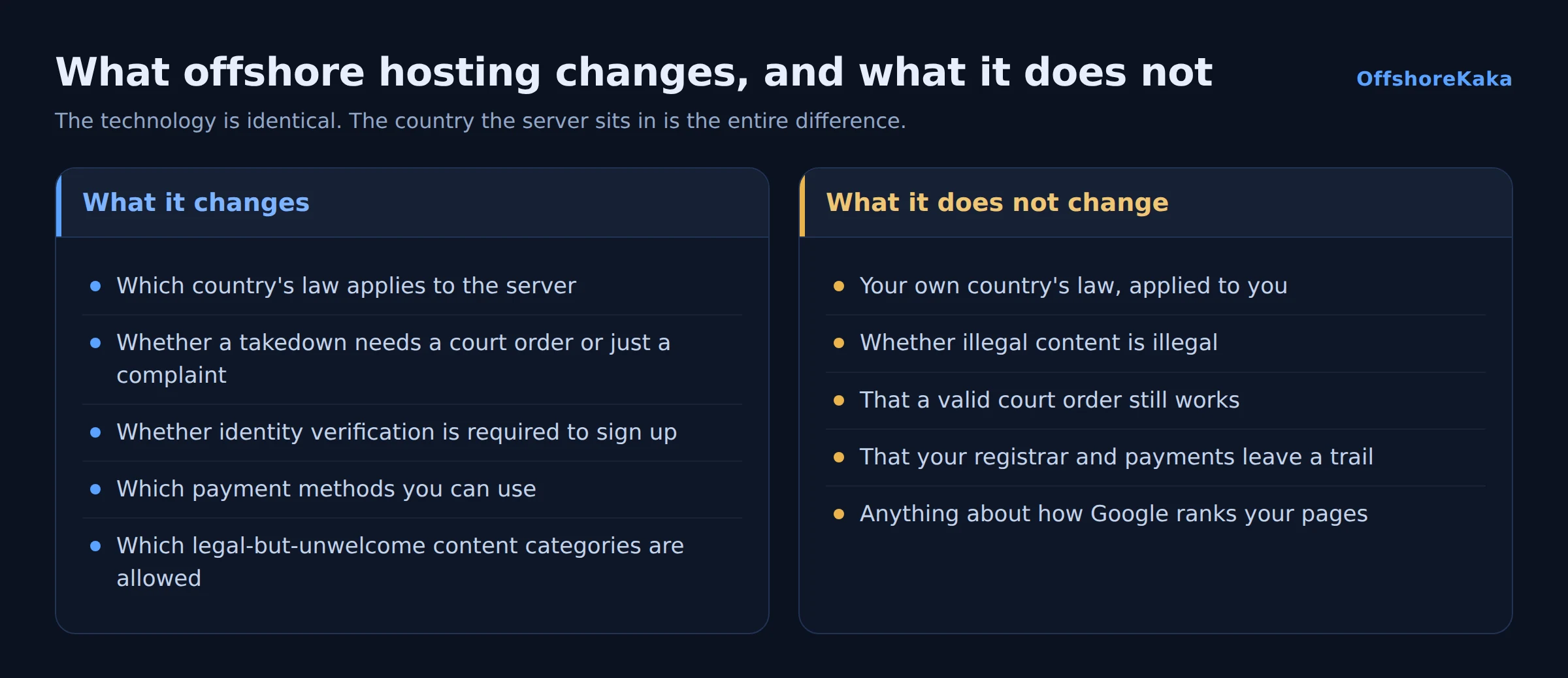
The only real difference is which country the server sits in, and therefore whose laws apply to it. Everything worth comparing flows from that one fact.
The four real differences
1. Whose law applies
This is the whole thing. A server in Frankfurt is governed by German and EU law. A server in Mumbai is governed by Indian law. Data protection rules, what a court can compel, and what a complaint alone can achieve all differ, and they differ in ways that matter if you host anything anyone might object to.
2. How takedowns work
With a lot of mainstream hosts, a complaint email is enough to get content suspended while it is investigated, and the burden falls on you to prove it was fine. Serious European hosts generally require a court order or a properly formed legal notice.
For a bakery’s website this never comes up. For a forum, a news site, a review site or anything with user generated content, it is the difference between a bad week and a lost business. Read any host’s abuse policy before you buy, offshore or not.
3. What you have to hand over
Mainstream hosts increasingly require identity verification, a card in your own name, and sometimes documents. Offshore hosts often accept cryptocurrency and ask for little beyond a working email address.
This is not about hiding from the law. Plenty of people have ordinary reasons not to attach their legal identity to every service they use, and privacy is a legitimate preference rather than an admission of anything.
4. Content policies
Every host has an acceptable use policy, and every host’s includes the obvious prohibitions. What varies is the grey area: adult content, gambling, file sharing, cryptocurrency projects, political material. Mainstream hosts often prohibit these outright, offshore hosts more often allow them within the law of their jurisdiction.
Side by side
| Offshore hosting | Regular hosting | |
|---|---|---|
| Server software | Identical | Identical |
| Control panel | cPanel, aaPanel, the usual | The same |
| Jurisdiction | Chosen deliberately | Usually wherever the company is |
| Takedown trigger | Often a court order | Often a complaint |
| Payment | Crypto commonly accepted | Card, usually verified |
| Content rules | Broader, within local law | Narrower |
| Speed for a European audience | Excellent from AMS or FRA | Depends entirely on location |
| Price | Comparable | Comparable |
What about speed?
The assumption is that offshore means slow. It does not, and the reasoning is worth spelling out.
Latency depends on distance from your visitors, not from you. If your audience is in Europe, a server in Amsterdam is the closest thing you can get. If your audience is in India and your server is in Frankfurt, you add roughly 120 to 150 milliseconds of round trip. That is real but it is small next to what an uncached WordPress page costs, which is routinely 500 milliseconds or more of server time.
In other words, caching and server tuning swamp geography. A cached page from Amsterdam reaches an Indian visitor faster than an uncached page from a server down the road. Our TTFB guide shows how to tell which one is actually costing you.
Amsterdam and Frankfurt also happen to host AMS-IX and DE-CIX, the two largest internet exchanges in Europe, so routing from those cities is unusually good in every direction.
When each one wins
Regular hosting is fine if your site is a local business, your audience is nearby, your content is uncontroversial, and you have no particular privacy requirement. Most websites are this, and there is no reason to overthink it.
Offshore hosting is the better choice if any of these apply: you host user generated content and cannot afford complaint-driven suspensions; your audience is European; you want stronger data protection than your own country provides; you need to pay without identity verification; or your content is legal but sits in a category mainstream hosts refuse.
Before you order
- Confirm the actual datacentre, not the company’s registered address. Many hosts are registered in one country and rent racks in another.
- Read the abuse policy. This is the document that determines what happens on your worst day.
- Test the network. Ask for a test IP and run a traceroute from where your visitors are.
- Check the renewal price, not the first term.
- Ask support a technical question before paying and see what comes back.
Buyer checklist
- Datacentre location confirmed.
- Abuse and takedown policy read in full.
- Network tested from your audience’s region.
- Backups included and restorable by you.
- NVMe storage confirmed.
- Renewal pricing understood.
- Support responsiveness tested.
Weighing up a move?
OffshoreKaka hosts in Amsterdam and Frankfurt with a published abuse policy, crypto payments and free migration if you are coming from another host.
FAQ
Does the server’s country change my Google ranking?
No. Google works out which country a site targets from the domain extension, the language of the content, and the setting in Search Console. Server location is not a ranking factor. What does matter is speed and uptime, and both belong to the server rather than to the map.
Is offshore hosting more expensive?
No, prices sit in the same range. What differs is that offshore hosts are less likely to run aggressive first-year discounts, so the headline price often looks higher next to a mainstream host advertising a heavily discounted introductory rate that triples on renewal.
Can I move an existing site over?
Yes, and it is routine. Copy the files and database, test on the new server before touching DNS, then switch. Rankings are unaffected as long as URLs stay the same and there is no downtime. Our migration guide has the steps.
Is offshore hosting only for questionable sites?
No, and the reputation is mostly a hangover from a decade ago. Today the typical customer is a business that wants European data protection, a developer who wants a permissive host that will not suspend on a complaint, or someone whose audience is simply in Europe. There is more on this in who should use offshore hosting.